About / Profile

My work has changed many times. The way I approach problems, much less so.

I have worked in very different environments: shipyards, live events, industry, international projects, infrastructure, web, marketing, digital systems, training and, today, artificial intelligence.

The common thread has never been one particular technology.

It has always been understanding how things work, identifying what is not working, finding a solution and taking it all the way into reality.

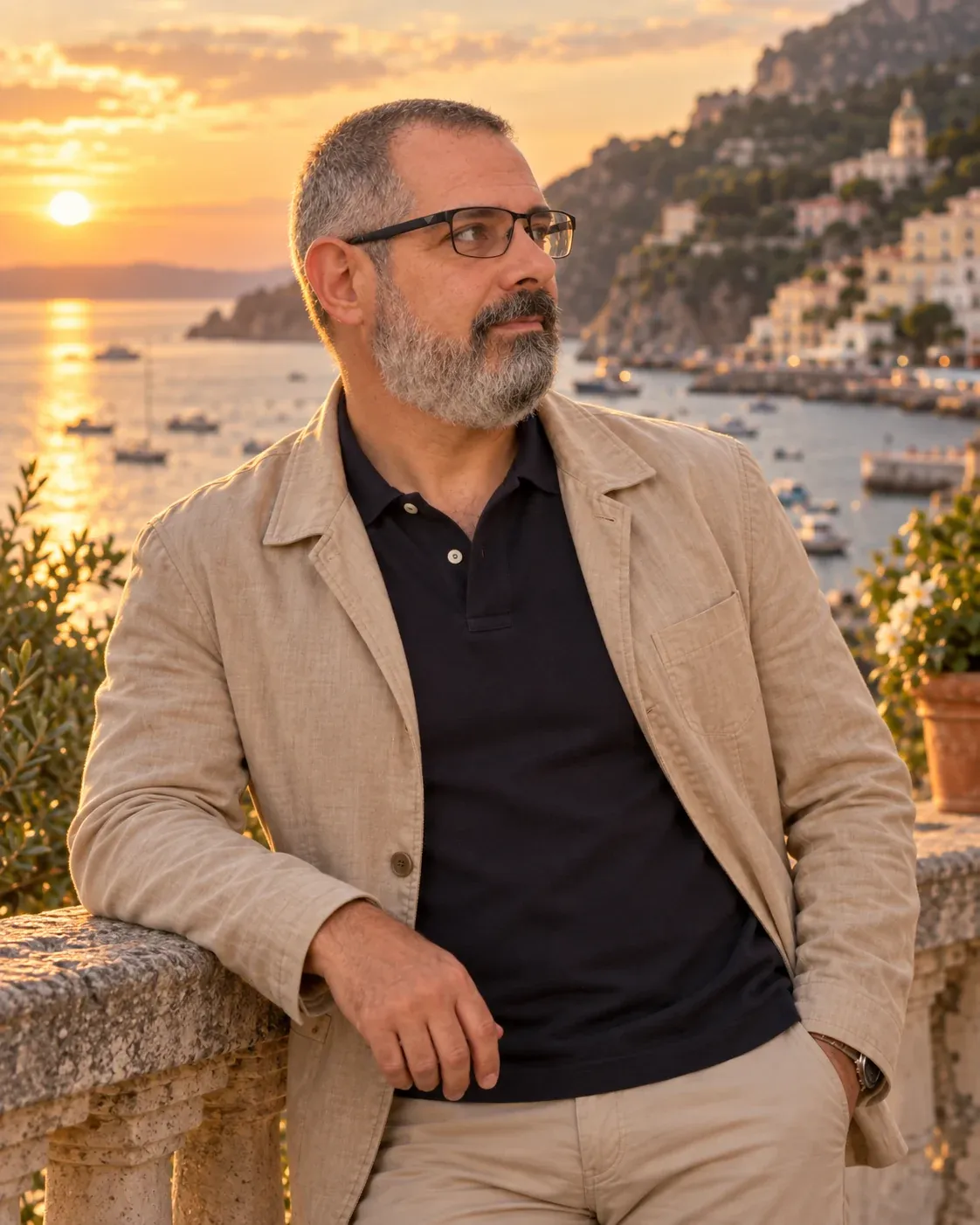
Marco Franceschi in an editorial portrait
Marco Franceschi — continuity through change
I am interested in what can work better, what does not exist yet, and what new technology can make possible.
Let’s discuss your project

Origins

I learned early that autonomy and responsibility belong together

My father owned a shipyard. When I was fourteen, he sent me to work there during the summer under an experienced worker, learning the trade in the traditional way.

That experience taught me the value of practical work, but it also made me understand something about myself: I find it difficult to follow a procedure blindly when I can see a better way to reach the outcome.

I have always looked for professional autonomy, not as a way to avoid responsibility, but as a way to take it.

I started working independently at eighteen and registered for VAT. Since then, most of my professional life has developed as an independent consultant and, at different stages, as an entrepreneur.

Autonomy only has value to me when it comes with responsibility for the outcome.

The industries changed. The role changed much less.

When I was younger, I also worked in the live entertainment sector. I created a company with a radio station providing audio and lighting services and organising events and shows, before continuing independently.

Technical and industrial assignments followed, both in Italy and abroad.

I worked on projects and assignments involving organisations such as Snam Rete Gas, Snam Progetti, Hamworthy Combustion and Sirma Refractories, including work in Qatar, the United Arab Emirates and Romania.

The environments changed, but I repeatedly found myself in a similar position: understand the project, observe what was really happening, identify problems and help determine the right way to reach the intended result.

The technologies and environments I worked in changed many times. The role I naturally ended up taking changed much less.

Field experience

From the drawing to reality

One of the periods that most influenced the way I work was technical supervision on industrial sites.

I would receive project documents, drawings and technical specifications and travel to the site to represent the company that had assigned me the work.

My role was, essentially, to be the company’s eyes and voice on site: verify that what had been designed was being built correctly and intervene when reality did not match the specification.

In Slatina, Romania, I spent around a month and a half supervising the reconstruction of an approximately 80-ton rotary furnace and a roughly 20-ton walking beam, observing the work of dozens of workers, technicians and engineers.

On one occasion I stopped the work after identifying a problem in the preparation of the materials. The work already completed had to be corrected and redone.

At other times, engineers and technicians on site would involve me directly in finding practical solutions to installation and construction problems.

Those experiences left me with a principle I still apply to digital projects today:

A solution is not good because it is correct on paper. It is good when it works in the real environment in which it has to operate.

Entering and growing through digital

Technology was already there

Alongside technical and entrepreneurial work, computers, networks and the Internet were already a constant presence in my life.

From a young age I spent a great deal of time online, experimented with systems and technologies and even administered gaming servers. Digital technology was not a later career conversion: it was already part of the way I worked and of my curiosity.

Around twenty years ago, the web progressively became the centre of my professional activity.

With the first CMS platforms, particularly Joomla, I realised that capabilities that had become natural to me could be turned quickly into useful tools for businesses.

From there, the growth was continuous.

One capability led to another

Whenever a project reached a boundary, I tended to want to understand what was on the other side.

Building a website soon meant understanding how people would find it.

Visibility led to marketing.

Marketing led to measurement, conversion and commercial processes.

Platforms led to servers and infrastructure.

Systems led to integrations.

Integrations led to automation.

Today, artificial intelligence is creating a new layer across many of those capabilities.

I have never seen these areas as completely separate professions.

That is how my work expanded over the years from the web into digital strategy, marketing, Linux infrastructure, systems, APIs, automation, data and AI.

I did not replace my earlier experience with digital technology. I brought that experience into digital technology.

Entrepreneurship and present

Not only consulting. Entrepreneurship too.

In recent years I have combined consulting with direct entrepreneurial experience.

I created a company around Aggregiamoci Online and another to develop the My Own SMS application.

Not every project follows the trajectory imagined at the beginning. Some require you to stop, rethink the model and start again. I have recently taken My Own SMS back under my direct responsibility and am developing the project independently again.

I have also built relationships and collaborations with a range of organisations, including internationally. One of these is Complitaly, a London-based company I currently work with.

Having been on the other side of the table changes the way I evaluate a project.

When I recommend an investment, a technology or a new initiative, I know that building it well is not enough. It must also make economic and operational sense and remain sustainable over time.

A project should not only be possible. It should be worth building.

Today: connecting what used to be separate

Today my work combines experiences that once would have seemed to belong to completely different worlds.

Strategy, technology, web, marketing, infrastructure, systems, automation and training can all become part of the same project when they serve the same outcome.

Artificial intelligence is expanding that space even further.

I use it every day in development, automation, analysis, project design, technical management and the production of systems and content. I see it as one of the most important technological transformations of the current period, while continuing to apply the same criterion I have always used:

Technology becomes valuable when it helps solve a real problem better.

Alongside consulting, I continue to teach and to develop new projects and collaborations in areas I consider strategically important, from AI to integrated systems and smart-building technologies.

Not because I want to accumulate unrelated activities, but because I remain attracted to the points where capabilities, technologies and markets begin to meet in new ways.
Professional principles

Saying what needs to be said

In a client relationship, I try to be present, available and direct.

If I believe a decision is wrong, a piece of work has not been done properly, or a problem may compromise the outcome, I tend to say so.

It is not always the easiest route, but I would rather address an issue while it can still be corrected than explain it after it is too late.

I have high standards for professional work and little tolerance for superficiality where competence and responsibility are required.

Over the years I have also learned that taking responsibility does not mean personally controlling everything. It means creating the conditions for the right people to work well and for the project to remain coherent.

Frankness may create a difficult conversation. Superficiality creates much more expensive problems.

Understanding the problem before choosing the solution

One of the capabilities I consider most important in my work does not belong to any particular technology.

It is the ability to understand what the real problem is.

A client’s initial request is often only the starting point. Behind a website that “does not work”, a slow process, software that needs replacing or a project that will not move forward, the real causes may be completely different.

That is why I ask questions, pay attention to signals that may initially appear secondary and look for connections across different areas.

An important part of my work is understanding what the real problem is, even when it initially appears in another form.

Trust, autonomy and continuity

The best professional relationships I have built over the years are those in which competence has been joined by mutual trust.

I work best when objectives and responsibilities are clear and, within that framework, there is enough autonomy to make decisions and move the work forward.

The client should never lose control of their own project. They should always know where we are going and why, without having to manage every operational step.

That is also why I tend to prefer relationships that can evolve over time rather than purely occasional assignments.

Future

Keep looking ahead

I do not know which technologies I will be using five years from now.

Some of the tools I use today will probably have changed completely. Others that currently seem marginal may have become normal.

It has happened many times before.

What I do know is that I will continue doing what I have always done: observe what is changing, understand what may become useful, and find a way to turn it into something that works in the real world.

Technology changes. My curiosity about what may become possible changes much less.

The future interests me most when it can be built.

Tell me what you want to build